Wednesday, January 25, 2012

Visit of Potato Late Blight diseased field of Farmer


Visit of Potato Late Blight diseased field of Farmer at Sripur Village of Natore Soder Upa Zilla, Bangladesh.

On 17 January 2012, Dr. M. A. K. Mian and A. Alam have visited the farmers' Field of Potato at Sripur village of Natore Soder Upa Zilla in Bangladesh. The potato field is infested with late blight disease. Dr. Mian is suggesting about control measures of the disease and supplying leaflets among the present farmers.

Late blight disease of potato and its control measure


<!--[if gte mso 9]> Normal 0 false false false EN-US X-NONE X-NONE MicrosoftInternetExplorer4

Late blight disease of potato and its control measure

M.A. K. Mian, K.M. Khalequzzaman and N. Ara

Regional Agricultural Research Station, BARI, Ishurdi 6620, Pabna

Late blight is a serious disease of potato in Bangladesh. A huge yield loss occurred within very short time due to infestation of this disease. Experimental evidence indicated that yield loss was estimated about 25-50% due to infestation of this disease. Phytophthora infestans is the causal fungus for late blight disease of potato. At first water-soaked zigzag spots are appeared on tip and margin of leaves then spread to stem and tubers. Powdery white spores are visible under the infested leaves. Brownish ring spot are shown on the infested stem. Low temperature, fogy weather, high humidity and cloudy sky are favourable conditions for disease development.

The following measures can be applied for prevention and control of the disease:

1. Preventive measures:

a). Healthy seed should be used.

b) Irrigation must be stopped when disease incidence occurred.

c). Infested potato tubers should be removed during storage.

d). Harvesting of potato should be avoided at wet soil and after rains.

e). Harvested potato tubers should not covered with infested potato plants in the field.

f).Should cut and remove the potato plants at 85-90 days aged before harvesting.

2. Dithane M 45/Indofil (2 g/L of water) should be sprayed at 7 days intervals for preventive measure.

3. Prevailing of favourable weather for disease development:

a). Secure @ 2 g/L of water OR

b). Melodidew @ 2 g/L of water +Secure @1 g/L of water OR

c). Acrobat MZ @ 2 g + Secure @1 g /L OR

d). Acrobat MZ @ 2 g + Melodidew @1 g /L

Monday, January 2, 2012

Sodium chloride (NaCl) use in potato as fertilizer

Survey and identification of causes of sodium chloride use in potato in northerner of parts of Bangladesh

M.A.K. Mian, M.R. Islam and J. Hossain

Agronomy Division, Regional Agricultural Research Station

Ishurdi 6620, Pabna

Photograph: Dr. M.A.K.Mian is interviewing with farmer on NaCl use in potato at Baroipara village of Paba upa zilla of Rajshahi.

A diagnostic survey on sodium chloride (NaCl) use in potato was carried out on 28 December 2011, 29 December 2011 and 2 January at Bogra, Rajshahi and Pabna districts respectively. The selected locations were Valta village of Kahalur Upa Zilla, Pertakur village of Shajahanpur Upa Zilla at Bogra district, Baroipara village of Paba Upa zilla and Jeolmari village of Godagari Upa zilla at Rajshahi district and Gangmatal village of Ishurdi Upa zilla at Pabna district. Thirty farmers were interviewed at leach location. Information on sodium chloride use on potato has been given in Table 1.

Table 1. Farmers’ opinion on sodium chloride use in potato at different locations

Sl. No.

Location

Opinions of farmers (no.) on sodium chloride use on crops

Potato

Other crops

Yes

No

Yes

Crops

1

Valta village of Kahalur Upa Zilla


30


2

Pertakur village of Shajahanpur Upa Zilla


30


3

Baroipara village of Paba Upa zilla

30


yes

wheat and rice

4

Jeolmari village of Godagari Upa zilla


30

yes

wheat and rice

5

Ganmatal village of Ishurdi Upa zilla

10

20

yes

Litchi

Farmers of Valta village of Kahalur Upa Zilla and Pertakur village of Shajahanpur Upa Zilla at Bogra district do not use sodium chloride in potato and other crops. But the farmers of Baroipara village of Paba Upa zilla at Rajshahi district use sodium chloride in potato. Moreover, the farmers of Rajshahi district use sodium chloride in rice and wheat in some cases. The farmers of Ganmatal of Ishurdi Upa zilla at Pabna district use sodium chloride in litchi. The farmers opined that those who lend lands from others farmers, then they use sodium chloride in crops in hidden condition, especially at night. Moreover, they said, use of sodium chloride helps to suck up the nutrients from soil by the crops. But the soil becomes unfertile for the following years. One farmer opined that NaCl is used as a substitute of Muriate of Potash (KCl). The crop performance is good producing better yield when NaCl is used in potato. The scientific reason behind that there probably occurs cation exchange by Na+ replacing K+ in the soil. Reserved or unavailable (Adsorbed) K+ in soil is replaced by adding Na+ (Na+Cl-). Thus available K+ is useful for K loving of potato crop.

Friday, October 28, 2011

Dr. Md. Abul Khayer is instructing in the class at Bangladesh Open University.


Teaching Experience:
Dr. Md. Abul Khayer Mian is instructing in the class of Bangladesh Open University in 2011. He is the Tutor on the Subject of STATISTICS (BAE 5207) at ATI, Ishurdi 6620, Pabna. He has gathered sufficient knowledge in Statistics during his research since 1993 in Bangladesh Agricultural Research Institute. He has experienced on multiple regression and modeling during in his Ph.D. research under PM scholarship. He has also teaching experience on IRRIGATION SYSTEM AND MANAGEMENT (BAE 3201). He shares his knowledge and experience to the students and young colleagues. He is a man of cooperative. He is a co-supervisor of a Ph.D. student in University of Rajshahi.

Wednesday, October 12, 2011

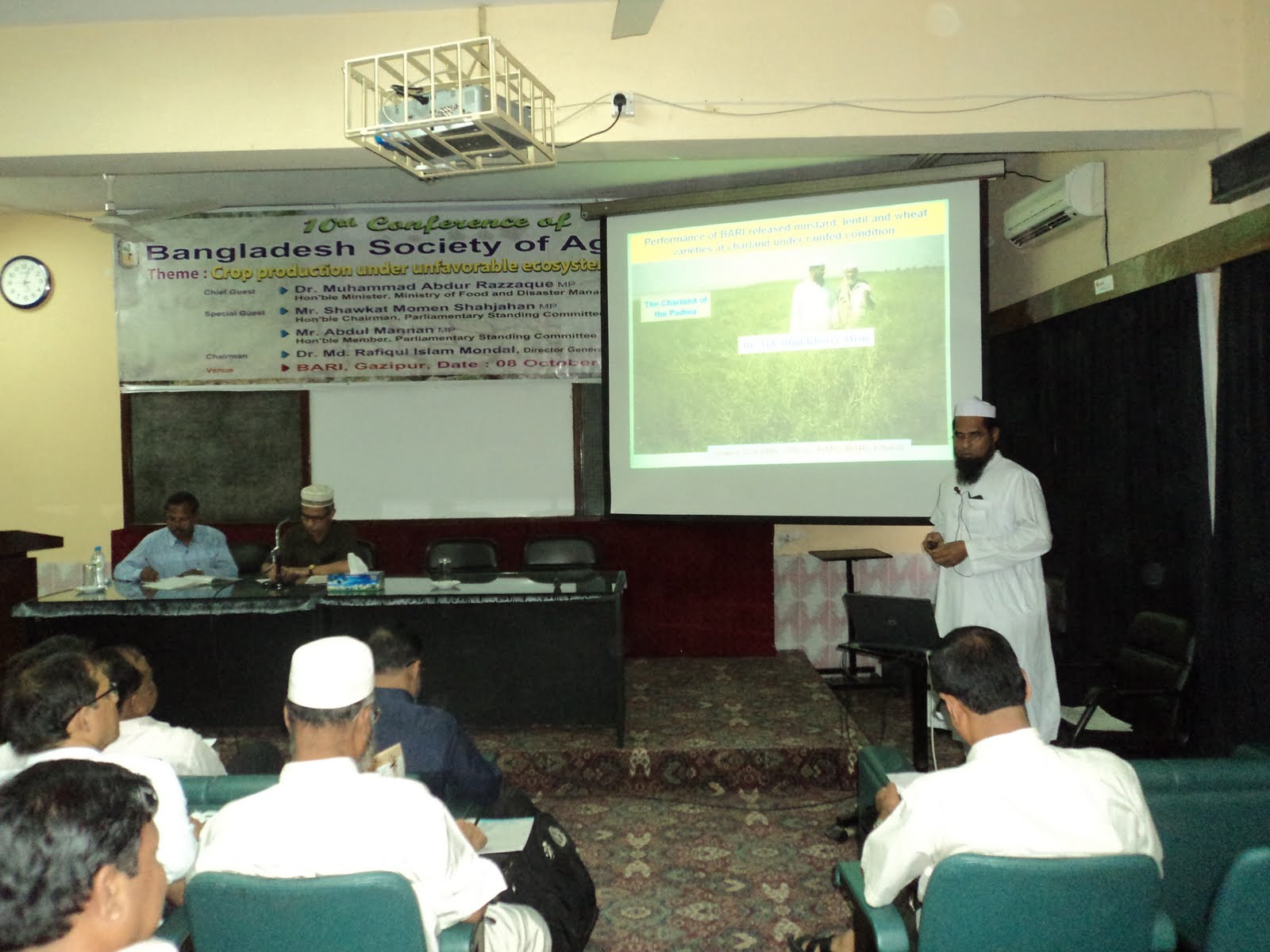
Paper Presentation at the Conference of Bangladesh society of Agronomy.


Dr. Md. Abul Khayer Mian is presenting a paper at the Conference of Bangladesh Society of Agronomy on 8 October 2011.

Paper Presentation at the Conference of Bangladesh Society of Agronomy

Dr. Md. Abul Khayer Mian has presented two papers at the Conference of Bangladesh Society of Agronomy on 8 October 2011. Titles of the papers were: 1. Performance of BARI released mustard, lentil and wheat varieties at charland under rainfed condition. And 2. Estimation of Nutrient level of BARI Sarisha 11 at charland. The papers were closely related to the Theme of the Conference like: Crop Production Under Unfavourable Ecosystems in Bangladesh.

Monday, September 26, 2011

CITIZEN CHARTER OF RARS, ISHURDI, BANGLADESH

CITIZEN CHARTER

Regional Agricultural Research Station, Ishurdi

(Dr. Md. Abul Khayer Mian)


1. Collection, Characterization, Preservation and Development of varieties of BARI mandate crops.

2. Development of improved and sustainable production technologies of wheat, maize, barley, millet, oil seeds, pulses, vegetables and fruits.

3. Development of insect and disease resistant variety of crops.

4. Development of drought and heat tolerant variety of crops.

5. Adaptive research at charland of adverse ecosystem.

6. Block demonstration of different technologies especially of varieties at farmers’ field.

7. Demonstration of technologies through BARI Technology Village (BTV).

8. Arrange of field days and training on different technologies.

9. Advisory services to farmers and relevant personnel for solving the problems on crop production.

10. Exchanges of knowledge and ideas with the visitors of home and abroad.

11. Student of different universities, colleges and schools experienced on

research activities of RARS.

12. Distribution of seeds and seedlings of vegetables and fruits occasionally to the farmers.

13. Monitoring of farmers’ field and providing solution of the problems.

14. Serve through dynamic website www.bari.gov.bd of BARI.

Source: RARS, BARI, Ishurdi 6620, Pabna, Bangladesh.